
Common wavelets and their properties#
A key property of the wavelet transform is its invertibility. Additionally, we expect an alias-free representation. Standard literature like [SN96] formulates the perfect reconstruction and alias cancellation conditions to satisfy both requirements. For an analysis filter coefficient vector \(\mathbf{h}\) the equations below use the polynomial \(H(z) = \sum_n h(n)z^{-n}\). We construct \(F(z)\) the same way using the synthesis filter coefficients in \(\mathbf{f}\). To guarantee perfect reconstruction the filters must respect
Similarly
guarantees alias cancellation.
Filters that satisfy both equations qualify as wavelets. Lets consider i.e. a Daubechies wavelet and a Symlet:
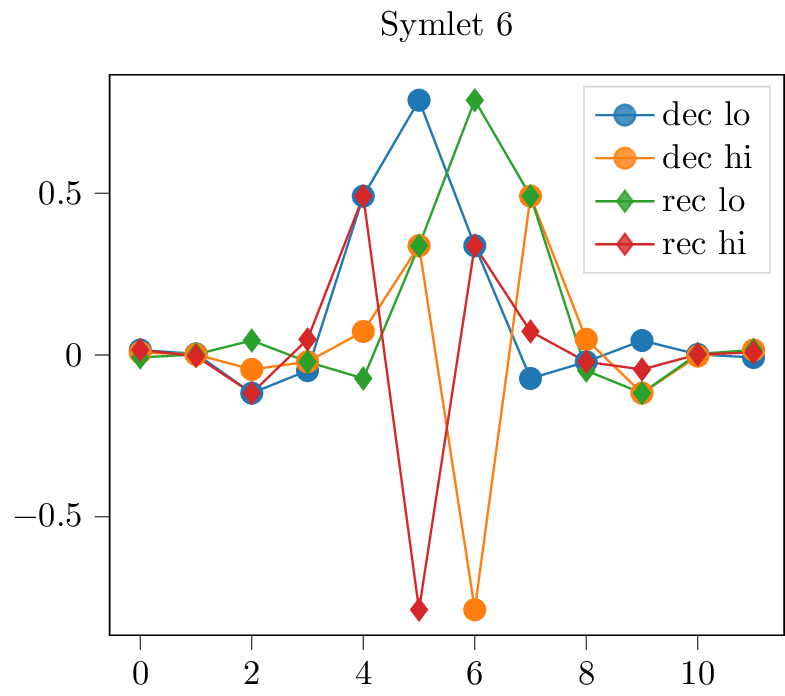
Fig. 13 Visualization of the Symlet 6 filter coefficients.#
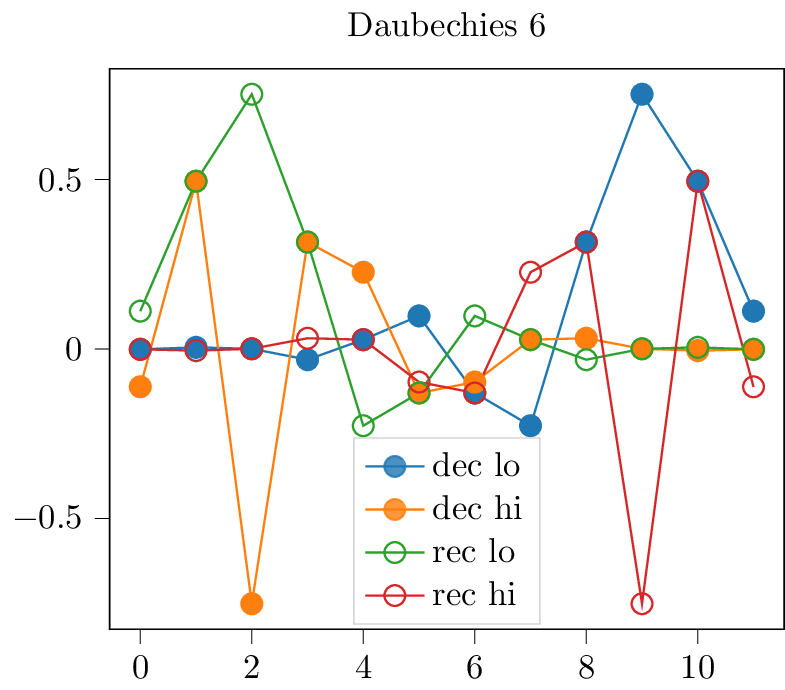
Fig. 14 Visualization of the Daubechies 6 filter coefficients.#
Fig. 13 and Fig. 14 visualize the Daubechies and Symlet filters of 6th degree. Compared to the Daubechies Wavelet family, their Symlet cousins have more mass at the center. Fig. 13 illustrates this fact. Large deviations occur around the fifth filter in the center, unlike the Daubechies’ six filters in Fig. 14. Consider the sign patterns in Fig. 14. The decomposition highpass (orange) and the reconstruction lowpass (green) filters display an alternating sign pattern. This behavior is a possible solution to the alias cancellation condition. To understand why substitute \(F_\mathcal{A}(z) = H_\mathcal{D}(-z)\) and \(F_\mathcal{D} = -H_\mathcal{A}(-z)\) into the perfect reconstruction condition [SN96]. \(F_\mathcal{A}(z) = H_\mathcal{D}(-z)\) requires an opposing sign at even and equal signs at odd powers of the polynomial.